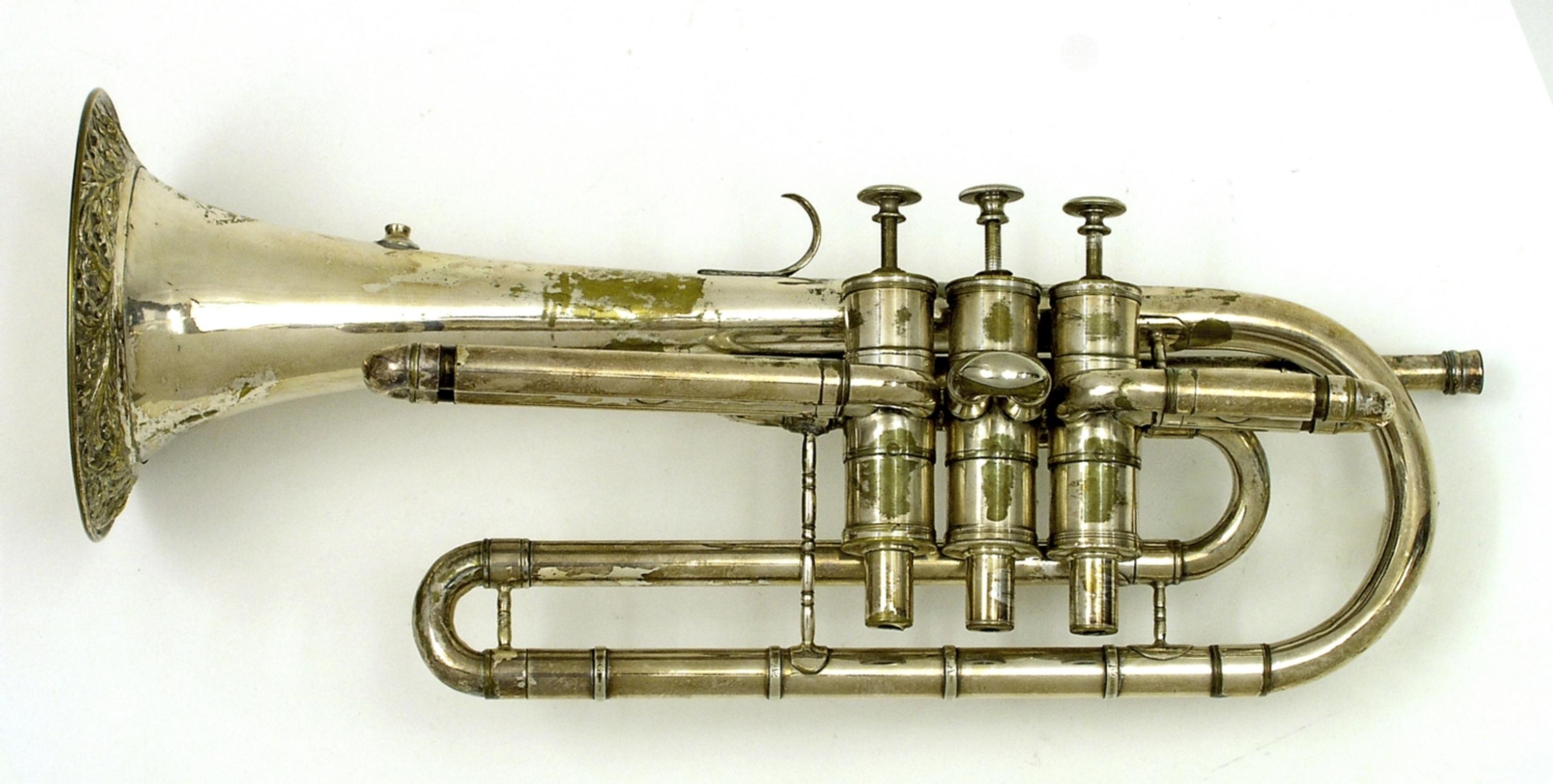
Cornet, nominal pitch: C | B.F. Richardson | Circa 1861
Cornet, nominal pitch: C | B.F. Richardson | Circa 1861
(opens in a new tab) (opens in a new tab) (opens in a new tab) (opens in a new tab) (opens in a new tab)
(Note: Each icon above opens in a new tab.)
Audio Clips
In the mid-19th century brass instrument makers were experimenting with a wide variety of designs for their instruments, including how the tubing should be wrapped and what type and number of valves should be used. This instrument is a wonderful example of both. The instrument is folded with the bell pointing back over the shoulder of the player and it has six independent valves. The valve system was an invention of Adolphe Sax (the inventor of the saxophone) and was adopted by John Bayley Sr., an English cornet virtuoso.
This cornet is one of a number of radical designs by John Bayley. The fingering system for this instrument is identical with Adolphe Sax’s independent valves: the shortest tube length (4-ft C) is obtained by operating the first valve, the next shortest (4½-ft B) is obtained by operating the second valve, and so on; the longest tube length (6-ft F-sharp) is obtained with no valves operated. However, in Sax’s design valves 1, 2 and 3 (for the right hand) are placed at 90° to valves 4, 5 and 6 (for the left hand) and each valve has its own tuning-slide. By placing the valves in line and spacing them by the correct distances, Bayley eliminated valve tuning-slides and made a far lighter instrument than Sax’s independent-valve cornet. There may be some disadvantages in not being able to tune the individual valves, but on the other hand there the system dispenses with combination of valves and the associated tuning errors are eliminated.
Related Instruments
Related Instruments