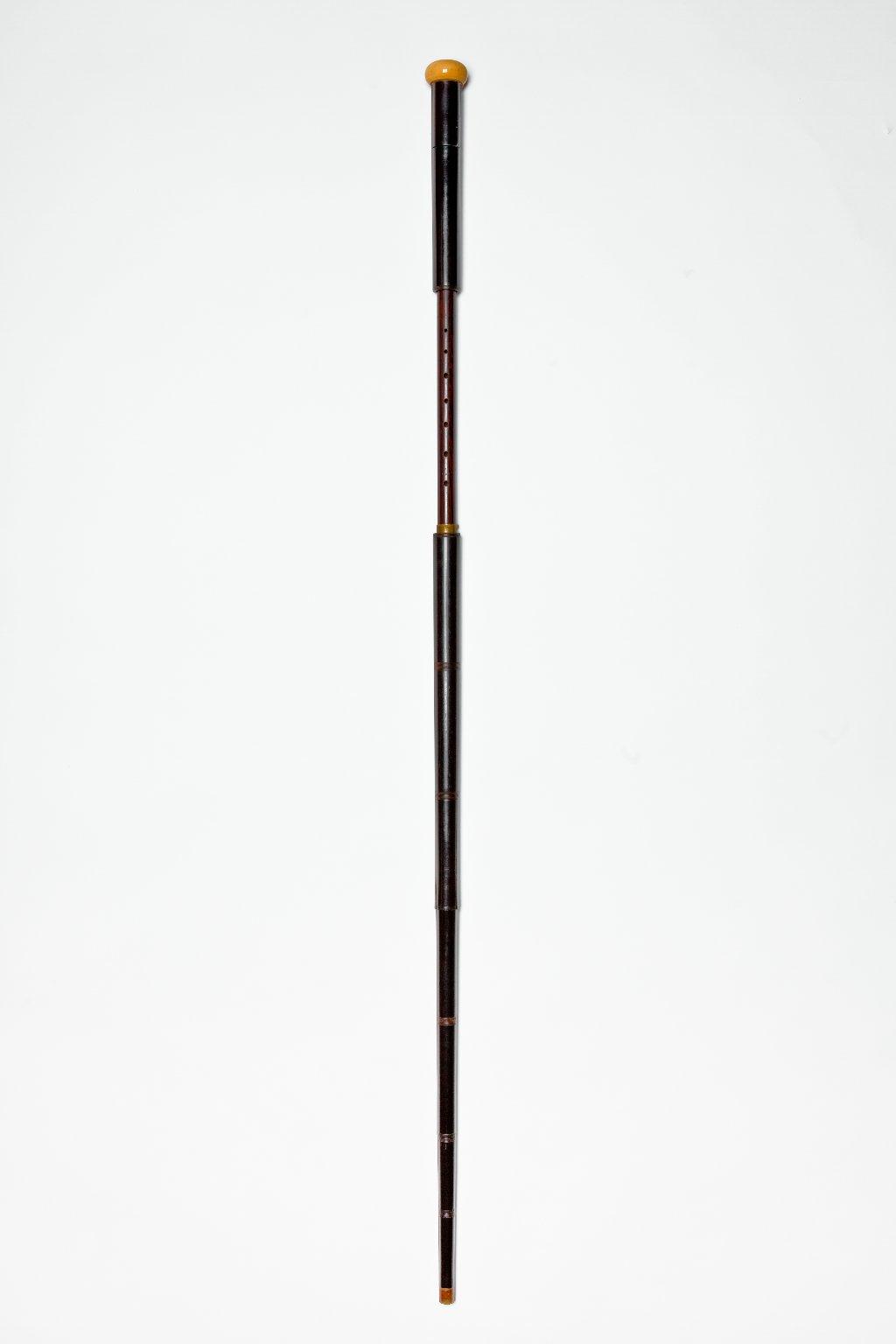
Border bagpipes get their name from the geographic region between Scotland and England but were in fact played much more widely. Instruments made on the English side of the border were also known as ‘big pipes’ to differentiate them from Northumberland smallpipes.
Technical description: The bagpipe is complete with all parts present and is accompanied by a set of bellows. All the wooden parts are of the same as yet unidentified hardwood of a dark golden-brown colour and with a good undisturbed patination. The mounts are of brass and bone.
The three drones comprise bass and tenor drones and a baritone drone playing at the fifth, an arrangement normally associated with the Northumbrian side of the English/Scottish border. The bass drone is in three joints and the other two in two joints.
The present bag is not of the highest order of workmanship and is almost certainly a later replacement. The present green baize outer bag with green fringed is old but is probably not original.
The bellows have flat mahogany boards. There are no metal hinge mounts. There are two pairs of holes for the leather hinge laces. Both the arm and lace belts run through brass loops. The valve bush is of bone. There is no way of determining whether these bellows have always accompanied this particular set but their early style means that this is at least a reasonable possibility.
Provenance
The previous owner was Robert A.S. Cowper, a former Chairman of the Northumbrian Pipers' Society and the first curator of the Cocks Bagpipe Collection after its bequest to the Newcastle Society of Antiquaries. The confirmed provenance goes no farther back than to Professor Edward Merrick, who was professor of geology at King's College, Durham and a keen amateur small-pipe player. Merrick's dates have yet to be established but the previous owner recalls acquiring the pipes from his sisters after his death some time in the 1950s. These pipes have been passed down with the traditional and purely verbal suggestion that they were formerly the property of William Lamshaw senior who was the piper to the Duke and Duchess of Northumberland between 1780 and 1800.
; Purchased with the assistance of the Heritage Lottery Fund, 2010.