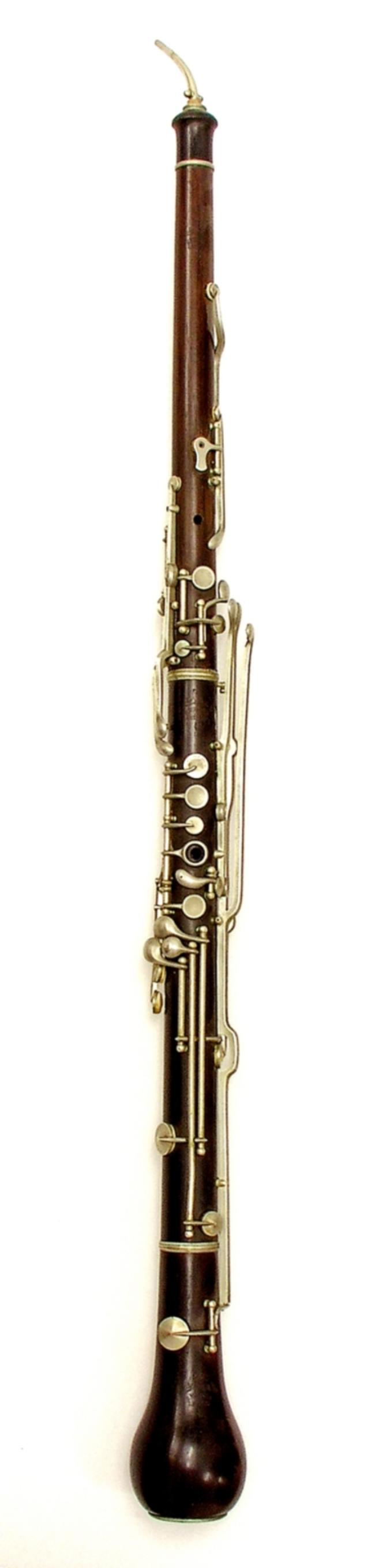
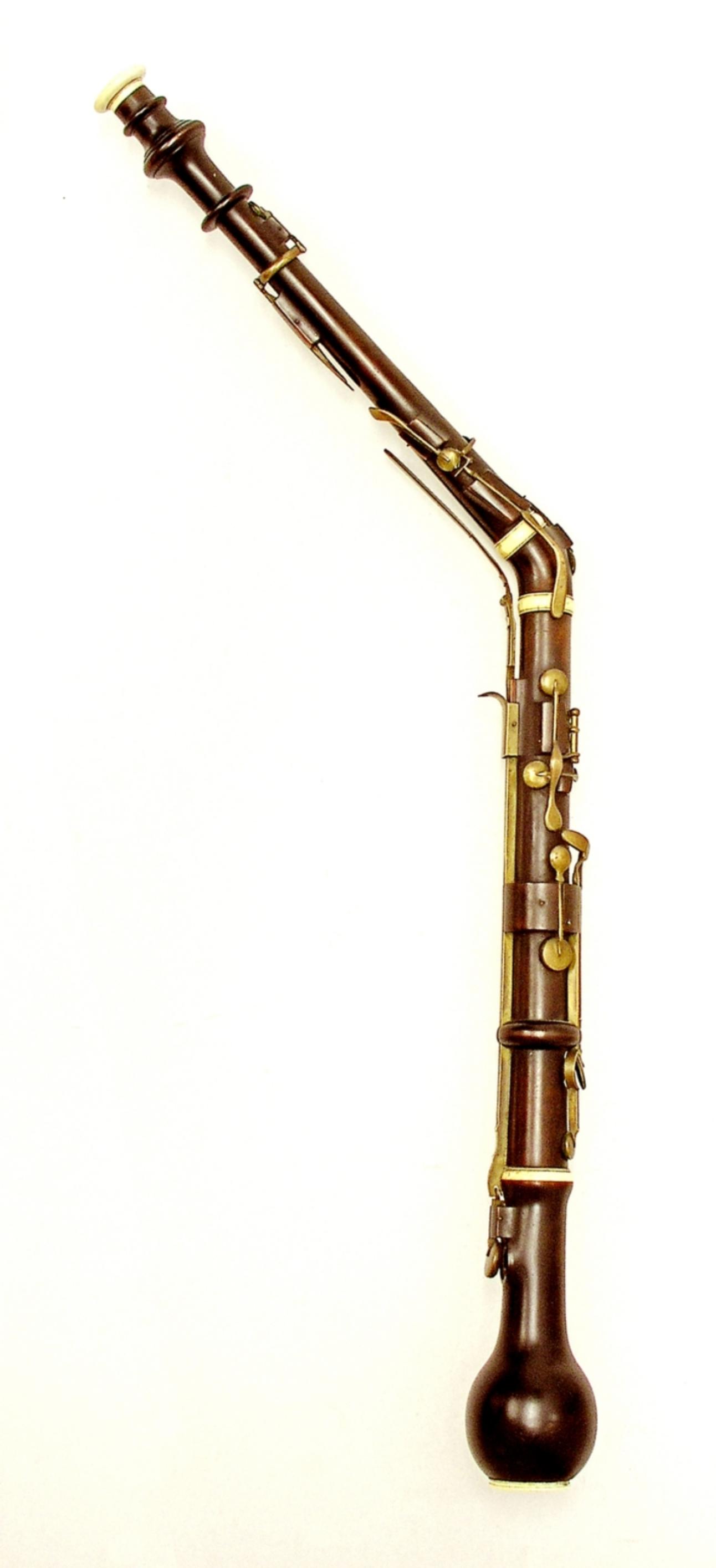
The curved cor anglais was made from a straight piece of
wood. The bore was drilled and the curve was the made
with a series of V-shaped cuts along the inside. The
instrument is covered in leather which protects the glued
joints and disguises the workmanship. . It is tooled with festoons and stars in gold leaf at each end of the two sections. On the upper and middle sections an inscription has been tooled in the leather in gold leaf: barbican-tower motif / “TRIEBERT / A PARIS”. The same marking is stamped on the bell, which is bare wood stained to match the leather.
Lent by J.W.Phillips. (Shaw-Hellier Collection).
The Triébert workshop was established in Paris in 1810 by Georg Ludwig Wilhelm Triébert (1770-1838) who hailed form Hesse where he had trained as a cabinet maker. Within a year he was granted French citizenship. In 1834, his oboes were considered by the Paris Exhibition jury to be superior to all the others there ¬– he was universally recognised as the outstanding oboe maker of his time. His sons and successors, Charles Louis (1810-1867) and Frédéric (1813-1878) were, respectively, a professional oboist and teacher but responsible for much of the firm’s technical innovations, and a metal engraver who also studied oboe.
Made In
City
Paris
Country
France
Description
Technical Description
Technical description: Probably maple with brass keys and wide (width c 20mm) ivory ferrules at crook well and sockets, there is also a narrow bell ring in ivory. The instrument is constructed with an overall curve and the upper and middle sections are covered with black leather which has ornamental tooling of festoons and stars in gold leaf at each end of the two sections. The bell is bare wood which has been stained black to match the leather. There is no onion shaped baluster at the top of the instrument.
10 keys
L0: 8.
L1: T.
L2: T.
L3: TT.
L4: G♯.
R0: low B; ring to take sling.
R1: T, B♭; C.
R2: T.
R3: T; F.
R4: low C; F♯; C♯; E♭.
Signature/Marks: On the upper and middle sections an inscription has been tooled in the leather in gold leaf: barbican motif / "TRIEBERT / A PARIS". The same marking has been stamped on the bell.
Repair History: A small vent hole in the bell, opposite the low B hole, has been stopped.
Provenance
Formerly on loan to the Collection.
; Accepted in lieu of inheritance tax by HM Government in 2025 from the estate of John William Phillips and allocated to The Musical Instrument Collection, University of Edinburgh